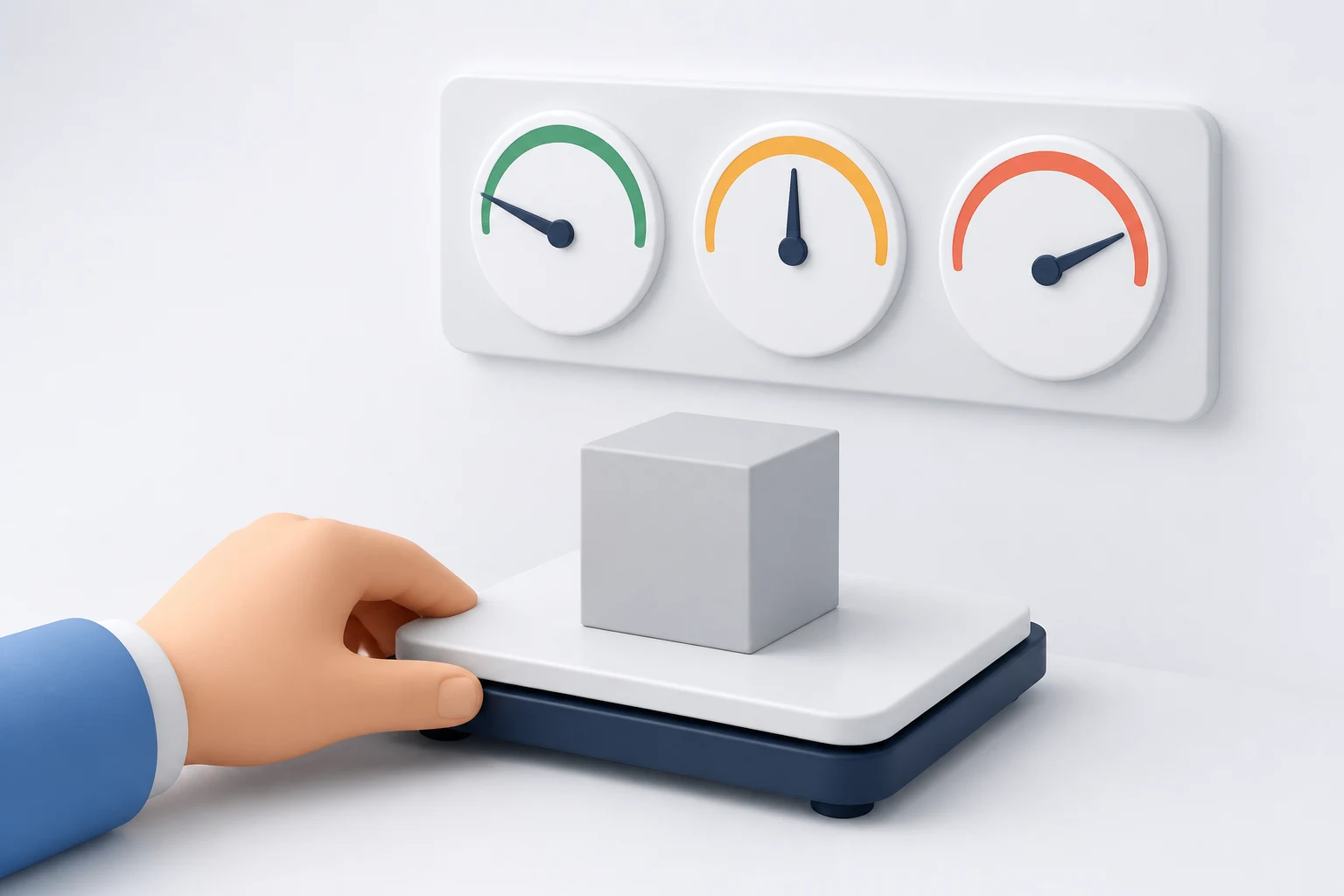
Scanner AI reads the output of GPT, Claude and Gemini for a living: its detector marks the fragments that match known generation patterns, and its ScanGo 2 model rewrites them without breaking keywords, headings or links. That work means looking at detector scores every day and watching how much they move. This guide explains where accuracy percentages come from, why human writing gets flagged, and what to do when it happens to you.
People who search “is AI detector accurate” want a yes or a no, and the honest answer is neither. Every score belongs to one model, one dataset, one threshold, one language and one sample of text; move any of those and the number moves with it. Read a result as a reason to look closer — at drafts, sources, version history and the conditions the text was written in.
What AI Detector Accuracy Actually Means
No tool is 100% accurate. Its score is a probability estimate drawn from language patterns, not proof of who wrote the text. A high result may warrant closer review, but it cannot establish authorship by itself. Formal or predictable writing can resemble the patterns in a detector’s reference data, so a human passage may be flagged.
Vendor claims and independent tests are not equivalent, and results change with text type, language, model, editing and the flagging threshold. A detector belongs next to drafts, sources and version history rather than in place of them, which is easier to hold on to when the distinction is spelled out:
- A score says how closely the wording matches learned AI patterns.
- It does not say who typed the words, or when.
- It moves with the model, the language, the length of the sample and the threshold.
Where AI Detector Accuracy Percentages Come From, and Who Measures Them
Vendors typically derive AI detector accuracy from labeled samples: text known to be human-written and text generated by specified AI models. The result depends on who chose those samples, how long they are, which language they use, and whether people edited the AI output. A percentage is only as useful as the test behind it.
Take the vendor view first. Turnitin has publicly claimed its AI detector is 98% accurate, and its product officer told BestColleges that the tool is deliberately tuned to find about 85% of AI writing and let roughly 15% pass, so that false positives stay under 1%. The balance between the two errors was chosen by the vendor, not discovered in the data.
An independent study takes the outside view. Researchers publishing in PMC ran 1,000 texts — 250 human-authored articles against 750 abstracts generated by ChatGPT 3.5, 4 and 4o — through GPTZero, ZeroGPT and Corrector App. The detectors told the two groups apart well above chance (AUC 0.75–1.00), yet none of them reached 100% reliability on that corpus.
- Check whether human and AI samples match your text type.
- Confirm which models, languages, and document lengths were tested.
- Look for separate false-positive and false-negative results.
- Treat anecdotes as examples, not representative measurements.
Reading AI Detector Accuracy, False Positives, and Recall
Accuracy measures how often classifications are correct overall. A detector may show high overall accuracy yet flag too many human-written passages or miss much of the edited AI text. This happens when one combined percentage hides the balance between different kinds of errors. The score reflects the chosen threshold: changing it changes which texts count as positive.
| Measure | Plain-English meaning |
|---|---|
| Accuracy | Share of all classifications that are correct. |
| False-positive rate | Human texts incorrectly flagged as AI. |
| False-negative rate | AI texts incorrectly accepted as human. |
| Precision | Share of flagged texts that are truly AI-generated. |
| Recall | Share of AI texts the tool detects. |
| Specificity | Share of human texts correctly cleared. |
| AUC | How well scores separate classes across thresholds. |
Raising the threshold may cut false positives, but it can also let more AI-generated text pass undetected. These results apply only to the dataset that produced them, so read the method before carrying an accuracy figure across to another language, genre, model or editing history.
False Positives: How Accurate Is AI Detector Output on Human Writing?
A false positive means that human-written text is labeled as AI-generated. Formal, repetitive, tightly structured prose can look like the statistical patterns a detector links to machine output. The University of San Diego law guide notes that non-native English and neurodivergent writers have been reported to face higher flagging rates, without presenting this as a universal outcome.
The guide reports that Turnitin had previously stated a false-positive rate below 1%, while a later Washington Post test found 50% in a much smaller sample. That contrast makes clear why are AI detectors accurate cannot be answered without context. Treating a score as conclusive evidence can lead to:
- Academic penalties or a disputed grade.
- Professional review, rejection, or disciplinary action.
- Reputational harm despite genuine authorship.
False Negatives: Are AI Detectors Reliable After Editing?
A false negative occurs when AI-generated text is classified as human or receives no confident warning. Are AI detectors reliable in this situation? Their confidence can drop when wording is edited, paraphrased, or reorganized, or when a different prompt produces less formulaic output. A detector may perform well on raw AI text but struggle with mixed drafts.
That limitation matters in practice: a low score does not prove that no AI assistance was used. It only means the submitted sample did not match the tool’s detection patterns strongly enough. The result reflects the detector’s uncertainty, not the complete history of how the text was produced or revised.
- Raw, repetitive output is often easier to classify.
- Editing can alter the signals a detector measures.
- Mixed authorship makes a single score harder to interpret.
Why the Same Text Gets Different AI Detector Accuracy Scores
AI detectors rely on different training data, models, thresholds, input limits, and definitions of an AI score. That is why ZeroGPT, GPTZero, Copyleaks, and Turnitin can produce conflicting results: the disagreement reflects differences in measurement, not proof that one result is automatically correct.
A controlled comparison of 160 samples, published by Deceptioner, reported the results below. These figures describe performance on that specific set, not on every kind of student, professional, or published writing. Because sample composition and testing conditions can shift the apparent ranking, the numbers need methodological context.
| Tool | Accuracy | False positives | AI recall |
|---|---|---|---|
| Turnitin | 82.50% | 1.28% | About 68% |
| ZeroGPT | 73.75% | 20.51% | About 67% |
Rerunning text or splitting it into parts changes the sample as well as the score: a shorter passage carries fewer signals. Record the tool, date, full text and result instead of keeping whichever answer supports your case — a screenshot without those four things cannot be re-checked by anyone, including you.
Is Copyleaks AI Detector Accurate? Independent Tests Explain
Copyleaks’ official detector page claims over 99% accuracy, but that figure comes from the vendor’s own methodology, not from a universal benchmark. Is Copyleaks AI detector accurate across every language and writing style? Independent results vary by sample: raw AI text is usually easier to classify than edited or mixed writing.
| Test or issue | Reported result and meaning |
|---|---|
| Raw ChatGPT essay | 100% AI detection in an EssayDone review test |
| Human-and-AI sample | 74.6% AI detection in the same test |
| QuillBot-processed text | 0% AI detection in that test |
| Plagiarism check | Finds text overlap, not proof of human authorship |
How accurate is Copyleaks AI detector in practice? A score can shift after revision because the tool evaluates AI-like language patterns, while plagiarism detection measures matching text. Copyleaks may be a useful screening signal, but is Copyleaks a good AI detector for sanctions? No score should independently determine an academic or professional penalty.
Is ZeroGPT a Good AI Detector? Reading a Free Tool's Score
Is ZeroGPT a good AI detector? Its percentage is meant to show how closely the wording follows patterns associated with AI, while highlighted sentences point to passages shaping the result. Neither display proves authorship or misconduct. Treat the score as a signal for further review, not a verdict on the writer.
A ZeroGPT review by Clever Humanizer tested nine AI samples from ChatGPT, Claude, and Gemini: all scored 100% AI, while all ten human samples received a non-zero score. This small test suggests that obvious output may be detected, but human writing can also trigger a flag.
In the same review, none of the ten human samples came back clean: Lewis Carroll’s Alice’s Adventures in Wonderland, published in 1865, scored 95.7% AI and The Wonderful Wizard of Oz from 1900 scored 88%, while the reviewer reports that five other detectors put both texts at or near zero. Both books predate the technology by more than a century, so those numbers measure the tool, not the authorship.
- A 0% score does not prove human authorship.
- A 100% score does not establish misconduct.
- Compare tools only when the dataset and source match.
Which AI Detector Is the Most Accurate, and Why That Is the Wrong Question
There is no universal answer to “which AI detector is the most accurate.” The better question is which error matters in your setting. An institution’s policy, the tool’s language support, document type, and tolerance for false positives may matter more than any headline percentage.
- Check false-positive results on comparable human writing.
- Check false negatives using relevant AI-generated samples.
- Treat claims about how accurate is QuillBot AI detector as context, not proof.
What to Do When AI Detector Accuracy Fails on Your Text
Save the report before the result changes: record the score, highlighted passages, date and the exact tool or version. Scores shift as vendors retrain their models, so a screenshot taken today may be impossible to reproduce next month. Keep the original document, and note whether you submitted the text in full or split it into smaller sections.
Process evidence can reveal how the text took shape. Ask what policy and evidence support the allegation, then request human review. Rewriting only to lower the score can damage clarity and still cannot prove authorship. A calm account of your drafting process helps more than claiming that another detector gave a friendlier percentage.
- Keep drafts, notes, citations, and research files.
- Preserve version history and relevant timestamps.
- Explain your writing process calmly and accurately.
- Disclose permitted AI assistance when required.
- Do not rely on a competing detector score alone.
Conclusion
AI detectors are not authorship tests, and no amount of decimal places makes them one. A score is a probability estimate shaped by the dataset behind it, the model, the language, the editing history and a threshold that somebody chose. Three things follow from that:
- Any accuracy figure is unreadable without its method and its sample.
- False positives and false negatives are both normal outcomes, not malfunctions.
- Evidence of how a text was written outranks any percentage in a dispute.